

How long before wedding should you get Botox? A reasonable planning window to discuss with your clinician is approximately four to six weeks before your wedding. This gives the treatment time to develop while allowing for an appropriate assessment of your results.
Your wedding day is filled with memorable moments, from walking down the aisle to smiling for photographs. If you’re considering Botox before your wedding, choosing the right appointment date deserves as much thought as the treatment itself.
How Long Before Wedding Should You Get Botox?
If you’re wondering how long before your wedding you should get Botox, approximately four to six weeks beforehand is a reasonable planning window to discuss with your clinician. This allows time for results to develop and for an appropriate assessment, although it does not guarantee a particular appearance.
The timing will vary based on factors such as the treatment area, your response, facial anatomy, and other key wedding events.
First-time patients may benefit from arranging a consultation several months earlier. Returning patients can review past treatment dates and experiences and schedule another appointment if appropriate.
For example: If your wedding is September 20, you might discuss a treatment appointment in early to mid-August. Your clinician may want to determine if that schedule allows enough time for the desired treatment and your situation.
Remember, Botox is an elective medical procedure. No scheduling window eliminates potential side effects or guarantees your desired cosmetic results.
How Long Does Botox Take to Work Before a Wedding?
Botox does not produce cosmetic results immediately. BOTOX Cosmetic contains onabotulinumtoxinA, a form of botulinum toxin that temporarily reduces activity in targeted muscles responsible for certain expression lines.
Understanding the Botox results timeline helps you distinguish early improvements from the final treatment response.
When Do Botox Results Start to Appear?
According to BOTOX Cosmetic, some patients may notice changes within one to two days when treating moderate-to-severe forehead lines, frown lines, or crow’s feet.
Three important milestones are:
Early onset: Some changes may be visible within the first couple of days.
Progressive improvement: Changes in muscles and appearance may still be developing.
Clinical assessment: Your provider monitors the response to the treatment at an appropriate time.
These milestones are dependent on the patient, product and the treatment indication. An early improvement is not necessarily the final outcome.
When Can You Expect the Full Botox Effect?
For the three facial-line indications mentioned above, BOTOX Cosmetic manufacturer describes full results at approximately 30 days. Some patients notice substantial improvements sooner, but two weeks should not be treated as a universal full-results deadline.
For example: Early changes could show up the next few days, following treatment on August 1, and the manufacturer’s full-results milestone is expected to be around August 31.
A review appointment could be sooner but assessment doesn’t necessarily imply another injection is required.
Different neuromodulators and treatment areas may have different timelines.
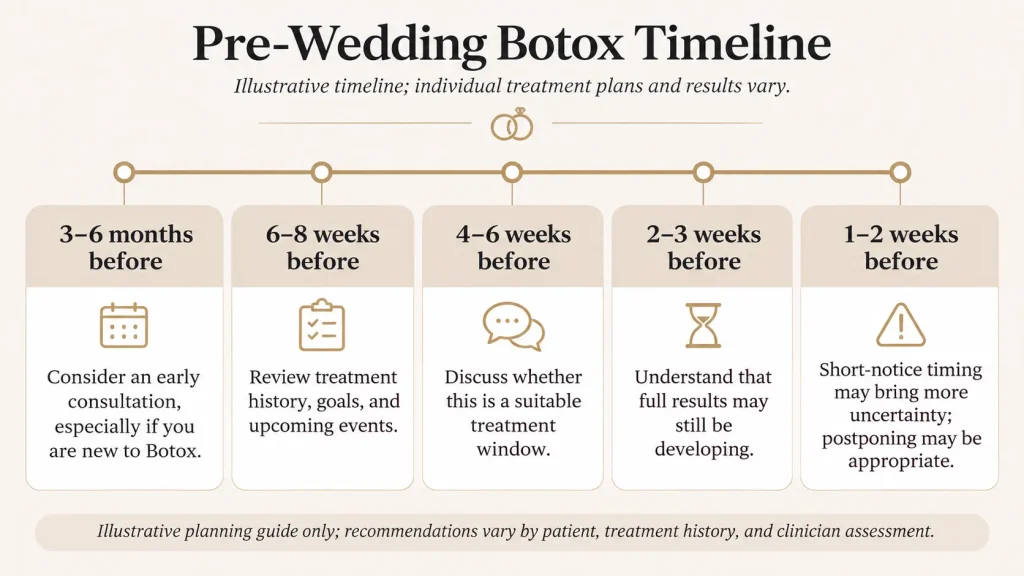
Pre-Wedding Botox Timeline: When to Book Each Appointment
A pre-wedding Botox timeline helps you decide when to get Botox before your wedding and should account for more than the ceremony date. Engagement photos, travel, past treatments, and individual recovery factors can affect scheduling.
The planning window in the following table is a guide only and is not a prescribed treatment regimen.
| Time Before Wedding | Planning Consideration | Important Caution |
| 3–6 months before | Consider an early consultation, especially if you are new to Botox. | An initial or trial injection is optional, not required. |
| 6–8 weeks before | Review treatment history, goals, and upcoming wedding events. | Treatment suitability requires clinical assessment. |
| 4–6 weeks before | Discuss whether this is a suitable treatment-planning window. | Results and recovery cannot be guaranteed. |
| 2–3 weeks before | Evaluate the remaining time and potential complications. | Full results may not yet be established. |
| 1–2 weeks before | Seek individualized advice about proceeding or postponing. | Short-notice treatments leave less flexibility. |
Illustrative planning timeline; individual treatment plans and results vary.
When Should Returning Botox Patients Schedule Treatment?
If you’ve received Botox before, your previous treatment experience can inform future scheduling.
- Check your treatment date: Document the last time you received Botox and which product was used.
- Review your response: Reflect on your previous results and how long they lasted.
- Discuss treatment intervals: The manufacturer recommends spacing BOTOX Cosmetic appointments at least 90 days apart.
According to the Prescribing Information, the safety and effectiveness of dosing more frequently than every three months have not been clinically evaluated. Wedding planning does not override this guidance.
How Should You Schedule Botox Around Wedding Events and Travel?
When planning Botox before engagement photos, your ceremony might not be your earliest important date.
For example: if engagement photographs are scheduled in June and your wedding is in September, discuss both dates during your consultation.
Plan around fillers or other skin procedures, rehearsal dinners, and honeymoon travel.
Each procedure may have different recovery considerations. When working with your clinicians, coordination can help prevent over-scheduled times and unreasonable expectations.
First-Time Botox Before a Wedding: Should You Start Earlier?
Planning first-time Botox before a wedding deserves additional consideration because you may not know how your body will respond.
An early consultation can help you consider benefits, limitations, and risks without making a rushed decision.
Important considerations include:
- Unfamiliar results: You have no previous experience showing how treatment affects your facial expressions.
- Individual response: Your results may differ from what you expect.
- Medical suitability: Treatment depends on your medical history and medications.
- Personal comfort: Consider whether you would feel comfortable with possible cosmetic changes before an important event.
You can also choose to postpone elective Botox until after the wedding.
When Should First-Time Patients Book a Botox Consultation?
Think about a consultation months before the wedding, especially if you’re curious about what the treatments will accomplish.
- Share your wedding schedule: Include photography sessions and travel dates.
- Explain your goals: Describe which facial movements or expression lines concern you.
- Review your health history: Talk about medications, conditions, and previous cosmetic treatments.
- Explore your options: Discuss realistic possibilities, risks and timings.
At Patients Choice Clinic, our Botox Treatment Services include individualized treatment planning based on facial anatomy and aesthetic goals.
Which Botox Treatment Areas Matter for Wedding Photos?
Botox is used regularly to treat some dynamic wrinkles, which occur from repeated facial movements.
Three treatment areas may be relevant when discussing Botox before wedding photos:
Forehead lines: Horizontal lines that appear when raising your eyebrows.
Frown lines: Vertical lines between your eyebrows that become noticeable when concentrating or frowning.
Crow’s feet: Fine lines around the outer corners of your eyes that often appear while smiling.
It’s not necessary to treat the lines just because they are seen in photos. The choice should be based on your anatomy, preferences and clinical suitability.
How Can Botox Affect Facial Expressions in Wedding Photos?
Botox relaxes specific muscles, possibly altering the way the face moves.
If you wish to hold certain expressions such as smiling, laughing or raising the brows during treatment talk about it first.
For example: A person with a talent for expressive photos may want to talk about minor movements instead of really relaxing the muscles.
Natural-looking Botox results depend on several factors and cannot be guaranteed. Unwanted weakness, drooping, or asymmetry can also occur.
Botox Bruising Before Your Wedding: Side Effects and Safety
Concerns about Botox bruising before your wedding are understandable, especially as photography and celebrations approach.
Although cosmetic Botox usually involves minimal downtime, that does not mean treatment is risk-free.
Potential reactions include:
- Injection-site bruising: Small bruises may appear and take varying amounts of time to fade.
- Temporary swelling or soreness: Mild localized reactions can occur after injections.
- Headache: Patients may have temporary headaches.
- Unwanted muscle effects: Facial weakness, eyelid drooping, or asymmetry may occur.
Risk can be elevated in certain medical conditions such as neuromuscular disorders. Contraindications include known allergy to botulinum toxin preparations, and infection at the proposed injection site.
Inform your clinician about medications, particularly muscle relaxants, certain antibiotics, and other products that may affect neuromuscular transmission.
Careful consideration should also be given to pregnancy and breastfeeding, as there is limited safety information.
Which Botox Side Effects Require Medical Attention?
Recognizing Botox side effects that require medical attention is important.
- Common temporary reactions: There can be a bit of pain, swelling, redness or bruising in the area. If symptoms get worse or you are worried, see your treating clinician.
- Symptoms requiring prompt clinical assessment: Unexpected facial weakness, eyelid drooping, significant asymmetry, or unusual changes should be evaluated by a healthcare professional.
- Emergency warning signs: If you have trouble breathing, swallowing or talking, or you experience signs of a severe allergic reaction, you need immediate emergency medical care.
The FDA-approved BOTOX Cosmetic labeling includes a boxed warning about the possible spread of toxin effects beyond the injection site.
How to Prepare for Your Pre-Wedding Botox Appointment
A thorough medical history and a clear understanding of your treatment goals come first.
Before your pre-wedding botox appointment:
- Review your health information: Prepare details about relevant conditions, allergies, and medications.
- Gather treatment records: Include any previous Botox or other neuromodulator injections.
- Check your calendar: Record important wedding dates, travel plans, and scheduled cosmetic procedures.
- Discuss aftercare: Follow your provider’s individualized instructions rather than relying on conflicting online advice.
According to the American Academy of Dermatology, it is advisable to discuss medications, supplements and previous procedures during a consultation.
What Should You Discuss at Your Botox Consultation?
Use this practical Botox before your wedding’s consultation checklist:
☐ Wedding date, rehearsal dinner, and engagement photo dates.
☐ Previous Botox treatments, products, and injection dates.
☐ Preferred treatment areas and facial-expression goals.
☐ Current medications, supplements, allergies, and medical conditions.
☐ Pregnancy or breastfeeding, when applicable.
☐ Upcoming fillers, facials, peels, or other procedures.
☐ Expected results, potential complications, treatment costs, and follow-up questions.
Share any concerns openly with your injector. Treatment should be considered at the discretion of a health care provider.
Is It Too Late to Get Botox Two Weeks Before Your Wedding?
Getting Botox two weeks before a wedding may be possible, but it is not necessarily advisable.
Because the manufacturer’s full-results timeline for specified facial lines is approximately 30 days, a two-week appointment might not allow enough time to assess the complete response. Bruising or unexpected cosmetic changes can also occur.
First-time patients have even more uncertainty due to a lack of experience in treatment.
For example: If your wedding is on September 20, but your first Botox appointment was on September 6, there might still be some changes in your look before your big day.
Scheduling within the final week leaves even less flexibility.
If your wedding is approaching, seek advice from a qualified clinician rather than rushing into treatment. Postponing elective injections until afterward may be a reasonable decision.
Frequently Asked Questions About Botox Before Your Wedding
Is Four Weeks Enough Time for Botox Before a Wedding?
Four weeks may provide a useful planning window because it aligns more closely with the manufacturer’s full-results timeframe for specified facial lines. However, suitability depends on your circumstances, treatment history, and clinical assessment.
Will Botox Last Through My Wedding and Honeymoon?
BOTOX Cosmetic results for specified facial-line indications can last up to four months. Whether results remain visible during your honeymoon depends on your treatment date, individual response, and the length of your trip.
Can I Get Botox Before My Engagement Photos?
Yes, if a qualified clinician determines treatment is appropriate. Plan around the engagement photo date itself, allowing time for results to develop and recognizing that bruising or unwanted cosmetic changes may occur.
Should I Schedule a Botox Touch-Up Before My Wedding?
A Botox touch-up before your wedding is not automatically necessary. A follow-up assessment might be helpful to assess results but further injections will only be clinically indicated and should follow the treatment-spacing guidance of the product.
Can Botox Be Combined With Fillers or Other Pre-Wedding Treatments?
Multiple cosmetic procedures may be considered through individualized treatment planning. Botox, fillers, and skin treatments address different concerns and have different risks and recovery considerations. Discuss scheduling with qualified providers.
Can I Have Botox if I Am Pregnant or Breastfeeding?
Safety information during pregnancy and breastfeeding is limited. Since wedding Botox is elective, consult with your healthcare practitioner if you’re having any concerns: you might want to wait for treatment instead of undergoing it without sufficient safety data.
How early should I get Botox before a wedding?
For wedding planning, consider discussing Botox treatment four to six weeks before the ceremony. This allows time for results to develop and for your clinician to assess your response. First-time patients may benefit from an earlier consultation, as outcomes vary.
How soon before a big event should I get Botox?
For an important event, a four-to-six-week Botox planning window is often practical, especially when photographs are involved. BOTOX Cosmetic reports full results around 30 days for certain facial lines. Your treatment history, bruising, and clinician’s recommendations should guide individual timing.
Is it okay to get Botox 2 weeks before an event?
Botox two weeks before an event may be possible, but results can still be developing, and bruising or unwanted changes may remain visible. First-time patients should be cautious. A qualified clinician can help decide whether postponing treatment makes more sense.
What is the 4-hour rule for Botox?
The four-hour rule commonly means staying upright and avoiding lying flat for about four hours after Botox injections. This is traditional aftercare advice, although strong evidence is limited. Follow your treating clinician’s instructions, and avoid rubbing the injection sites afterward.
Plan Your Wedding Botox Consultation in Burbank, CA
Your wedding deserves thoughtful planning, and cosmetic treatment should be approached with the same care. Understanding treatment timelines, possible side effects, and your individual goals can help you make an informed decision.
At Patients Choice Clinic in Burbank, California, we offer personalized Botox services based on individual assessment. Whether you’re considering your first appointment or reviewing previous treatment experience, we’re here to discuss your options.
Ready to explore your timeline? Contact Patients Choice Clinic to discuss your wedding dates and treatment goals.