
Do you notice more of your gums than you would like when you smile? A gummy smile is a natural face trait, but some adults want a smile with less gummy tissue. Gummy smile Botox is a nonsurgical treatment that can sometimes be effective in cases where the gummy smile is caused by excessive movement of the upper lip.
Botox for gummy smile works by relaxing specific facial muscles, so that the upper lip does not lift as much when someone smiles. But treatment is not apt for all causes of gums that can be seen.
Understanding how the procedure works, what results to expect, how long they last, and the potential costs and risks can help you make an informed decision.
Find Your Gummy Smile Solution
What Is a Gummy Smile?
A gummy smile is caused by excessive gingival display, or the upper gum tissue being visible above the teeth when a person is smiling.
There is no single definition of an attractive smile. Over 3-4 millimeters of gum tissue showing is considered excessive by some dental references, but that is subjective. Don’t assume that if you are showing your gums there is something wrong with you.
A gummy smile can develop for several reasons:
- Hyperactive upper lip: Strong upper-lip elevator muscles lift the lip higher than usual when smiling.
- Short upper lip: A naturally shorter lip may cover less gum tissue.
- Gum and tooth anatomy: Gum coverage, changes in tooth eruption or shorter-looking teeth may make gums visible.
- Jaw structure: Excessive vertical dimension of the upper jaw may also be a factor in increased gum exposure.
Some people have more than one contributing factor.
It is important to know the cause because Botox does not alter the position of teeth, gums, or jawbones. An appropriate examination helps determine which treatment, if any, may be beneficial.
How Does Gummy Smile Botox Work?
Understanding how gummy smile Botox works begins with the muscles that lift your upper lip.
Botox consists of botulinum toxin type A, a prescription drug which temporarily inhibits the release of a chemical messenger called acetylcholine from the nerve endings. This will decrease the activity of the targeted muscles.
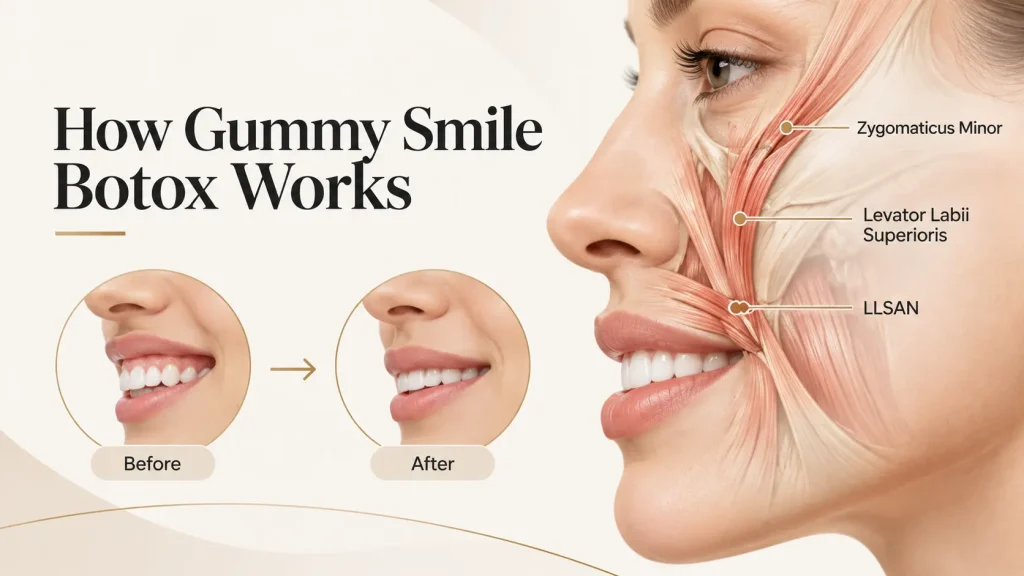
For excessive elevation of the upper lip associated with a gummy smile, the right muscle relaxation can be used to keep the lip slightly down when smiling. The purpose is typically to avoid the need to restrict facial movements while achieving a natural appearance.
Botox does not take away the gum tissue, alter the length of the teeth or move the jaw around like a dental procedure. Its effects gradually wear off.
Important: Using Botox to treat a gummy smile is an off-label cosmetic use in the United States. Although BOTOX Cosmetic is FDA-Approved for certain facial and neck concerns, gummy-smile correction is not an FDA-approved indication. It involves clinical judgment on an individual patient basis and informed consent.
Which Upper-Lip Muscles Does Botox Affect?
Several muscles influence how high your upper lip moves:
- Levator labii superioris alaeque nasi (LLSAN): Muscle that raises the upper lip close to the nose, and is a common study target for gummy smile treatment.
- Levator labii superioris (LLS): Lifts the upper lip, contributing to gum and tooth exposure.
- Zygomaticus minor: Helps elevate the upper lip and may contribute to certain smile patterns.
These muscles have to work in unison and not in isolation.
Not every gummy smile involves the same muscles. Before determining if treatment is indicated, the qualified clinician assesses movement, symmetry and facial anatomy.
Who Is a Good Candidate, and What Happens During Treatment?
Gummy-smile Botox may be worth considering when excessive upper-lip muscle activity is a significant cause of visible gums.
This will be dependent on your facial structure, medical history, current lip function, and desired results of treatment. An analysis should also be conducted to see if dental or skeletal aspects play a role in your smile.
Who Might Be a Good Candidate?
An adult with a hyperactive upper lip and realistic expectations may be a suitable candidate.
A clinician might want to think about:
- Does the upper lip rise excessively when smiling?
- Could gum contouring, orthodontics, or another dental treatment address the cause more effectively?
- Have any previous toxin reactions, neuromuscular conditions, swallowing difficulties, or medications which require extra attention?
- Can desired improvement be made without compromising mouth movements?
Allergy to the product or infection at intended injection site is contraindication. Safety information is limited for pregnancy and breastfeeding, so these also need special consideration.
What Happens During a Consultation and Treatment Visit?
There are 4 stages of a typical clinical process:
- Smile assessment: The clinician examines your lips and facial movements at rest and while smiling, checking gum visibility and symmetry.
- Medical review: A discussion of your medical history, medicines, cosmetic surgery experiences, goals and potential risks.
- Individualized treatment: If appropriate, a qualified clinician administers the selected prescription neurotoxin according to your anatomy and treatment plan.
- Aftercare and follow-up: You receive instructions and guidance on when the results should be evaluated.
There are short-term appointments for injections, but careful assessment is more important than the speed of treatment.
Gummy Smile Botox Before and After: What Results Can You Expect?
Gummy smile Botox before and after results generally involve a change in how far the upper lip rises during smiling.
If treated properly, there may be less gum tissue above the upper teeth. The teeth stay the same, and Botox does not give fullness to the lips.
The results of the improvement will vary with your natural smile, muscle activity, anatomy, and personal reaction.
A 2021 Meta-Analysis reported an average reduction in gingival exposure of approximately 3.42 millimeters at two weeks. This, however, was a wide-ranging variation, and should not be used as a guide to an individual patient’s prognosis.
Consider this fictional example:
Patient A: Their gums are more evident as the upper lip is too elevated. Focused muscle relaxation may cause a decrease in visible gums.
Patient B: They expose their gums mostly through their upper jaw structure. Botox can offer limited benefit due to its inability to modify the jaw.
Successful treatment should take into account the balanced, functional smile as opposed to the maximal possible reduction in lip motion.
How Long Does Gummy Smile Botox Take to Work?
Gummy-smile Botox does not work instantly after being injected.
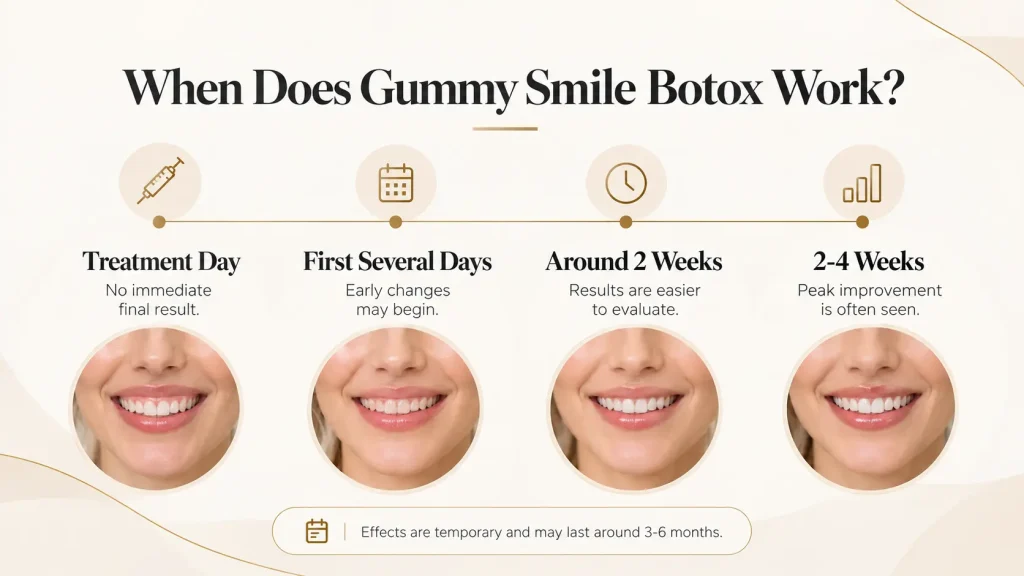
You may see some changes in as many days, and more complete results are usually observed in 1-2 weeks.
A 2024 systematic review showed that the improvement in the trials included in this review were greatest around two to four weeks after treatment.
A practical time frame is:
- Treatment day: No immediate end result.
- First few days: Slight muscle relaxing effects may start.
- About two weeks: Improvement is usually more apparent after two weeks.
- Two to four weeks: Effects are often reported to peak at this time in published studies.
Follow-up should be based on the advice of the treating clinician since individual timelines vary.
How Should You Compare Before-and-After Photos?
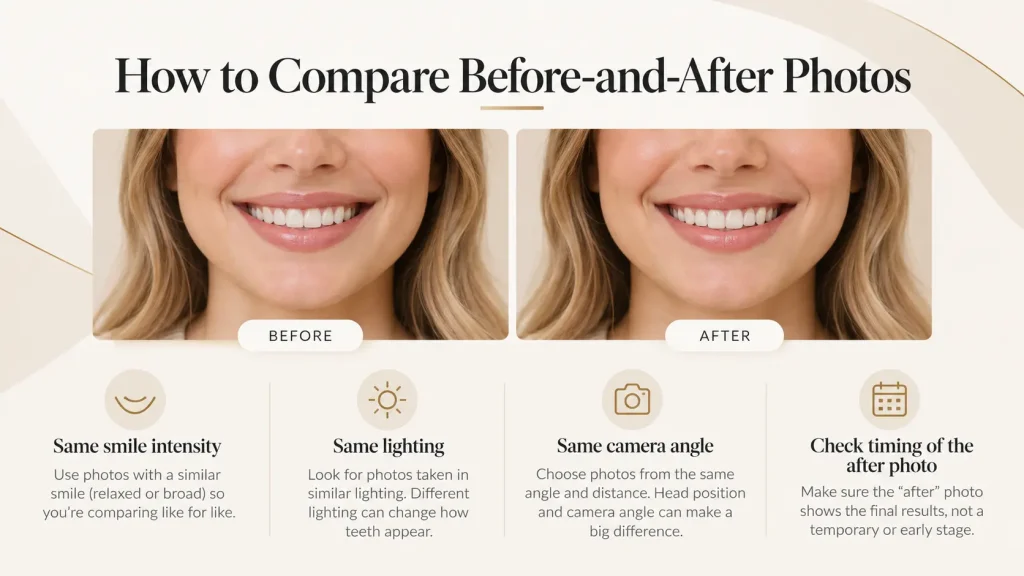
Before-and-after photographs are most helpful when they document comparable expressions and conditions.
Consider these details:
- Smile intensity: The two photographs should capture a similar natural smile.
- Camera position: Distance, angle, light and framing should be consistent.
- Treatment timing: The after-photo should identify when it was taken.
- Symmetry: Look at the overall balance of both sides of the upper lip.
- Authenticity: Prioritize real clinical images over manipulated or AI-enhanced images.
Keep in mind that a photo is just one snapshot. It is not able to show speaking, laughing or normal lip movement.
The results of other patients should set guidelines, not dictate your expectations.
How Long Does Gummy Smile Botox Last?
How long gummy smile Botox lasts depends on the individual, but treatment effects are temporary.
Clinical research frequently shows a significant decrease in gum exposure after about 12-24 weeks or about three to six months. That period may be one in which the effect diminishes a bit over time.
The treatment generally follows this pattern:
- First improvement: Movement of upper lip starts to shift in the first few days.
- Peak results: Gum exposure decreases most during the peak results.
- Gradual wearing off: Muscle activity slowly returns as the medication’s effect decreases.
- Maintenance: Repeat treatment may be considered after a new clinical assessment.
The length of time may differ depending on the activity of the muscles, facial anatomy, product, dosage, and response to the product.
The 2021 meta-analysis revealed that gum exposure returned to a level closer to baseline around 24 weeks, although there was some variability.
Repeated injections are not always required. It should be based on your satisfaction, your lips ability to function, your medical history, and the clinician’s evaluation, not on a set schedule.
How Much Does Gummy Smile Botox Cost?
Gummy smile Botox cost varies by provider, location, product, and treatment needs. No one price reflects all patients or clinics.
There are a number of variables that impact the total:
- Location and provider experience: Prices can vary between markets and medical practices.
- Individual treatment requirements: Different muscle patterns may require different treatment plans.
- Pricing structure: Clinics may charge per unit or apply a minimum treatment fee.
- Consultation and follow-up: Consultation and follow up are some of the practices included, but you may also need to pay for them separately.
- Maintenance: Temporary results can create additional long-term expenses.
Prior to booking, request a written quote for the entire treatment, rather than only the initial price listed.
Patients Choice Clinic publishes general Botox pricing on its Botox Treatment page, but that does not establish a gummy-smile-specific treatment price or confirm service availability.
How Many Botox Units Are Needed for a Gummy Smile?
There is no universally appropriate number of Botox units for gummy-smile treatment.
A clinician considers upper-lip movement, muscle strength, smile asymmetry, the treatment approach, and the selected product. There are different published protocols for dosing, and a single protocol is not suitable.
For instance, two hypothetical patients could have the same amount of gums and different muscle activity. Therefore, their treatments might vary.
Other neurotoxin products like Botox also have product specific units that can’t be interchanged.
Numbers of units should be prescribed by a competent clinician and not based on an online pricing list.
Is Botox or Lip Filler Better for a Gummy Smile?
Botox and lip filler both work differently and will be used for different issues, depending on your concern.
Sometimes lip filler for a gummy smile is mentioned as an alternative treatment, however lip filler is primarily used to add volume or alter lip shape. It does not directly perform the same function as targeted muscle relaxation.
Botox Lip Flip primarily targets the orbicularis oris muscle in the mouth area. Gummy-smile injections typically focus on muscles responsible for lifting the upper lip.
These options may include gum contouring, crown lengthening or orthodontics in some cases, lip repositioning or jaw surgery.
| Treatment | What It Changes | When It May Help | Main Limitation |
| Gummy-smile Botox | Relaxes selected upper-lip elevator muscles | Excessive lip elevation contributes to visible gums | Temporary; does not correct structural causes |
| Botox lip flip | Changes how the upper lip rolls outward | Upper lip turns inward while smiling | Does not add lip volume or replace targeted gummy-smile treatment |
| Lip filler | Adds lip volume and changes contour | Lip fullness or shape is the concern | Does not directly correct excessive lip elevation |
| Dental or orthodontic treatment | Addresses gum contours, teeth, or jaw-related anatomy | A dental, gum-related, or skeletal cause contributes | Suitability, treatment complexity, and recovery vary |
Can Gummy Smile Botox Go Wrong?
While the treatment can be successful in appropriate patients, it is possible to have bad gummy smile Botox results, especially when relaxing the muscles brings about an undesirable change in facial expression or function.
Temporary injection-site effects. Some discomfort, tenderness, swelling, redness, or bruising may be present around the treated area.
Uneven smile after Botox. Unequal effects on the muscles can cause temporary smile asymmetry. The upper lip may move up or down one side more than the other.
Excessive upper-lip relaxation. Excessive muscle weakening can cause an abnormally flat smile or that the lips may not move normally.
Speaking or drinking difficulties. Lips are important for speech, drinking, and facial expression, so unintended weakness can impact activities like pursing the lips or drinking through a straw.
Unsatisfactory cosmetic results. Not all patients will get as much improvement as they would like, or they may not like the way their smile looks. Botox does not guarantee symmetry or a particular appearance.
When should you seek help?. If any abnormal weakness, noticeable asymmetry or changes that affect normal activities occurs, contact the treating clinician.
Get medical help right away if trouble breathing or trouble swallowing, if large problems with speech, if symptoms are those of generalized muscle weakness. The FDA warns that botulinum toxin effects can rarely spread beyond the injection area.
No certain immediate treatment that can reverse the cosmetic muscle relaxing effect. Side effects that are not wanted may go away as time goes on, but the symptoms that concern you need to be checked out professionally.
Frequently Asked Questions About Gummy Smile Botox
A few frequently asked questions with answers about treatment, comfort, and recovery.
Does Gummy Smile Botox Hurt?
People do not normally experience long-term pain after injections, they often just feel a little pinch. Some tenderness or bruising may result and the upper-lip area may be sensitive. Symptoms of discomfort are different for different people. Discuss needle anxiety, previous reactions or pain management concerns before the treatment.
Is Gummy Smile Botox Permanent?
No, Botox inhibits activity of certain facial muscles without altering the muscle’s anatomy. Normal muscle movement usually returns as the action of the drug decreases. If a person wants to achieve the correction for a longer time, he or she should find out if the dental, periodontal, orthodontic or other structural treatment is appropriate or not.
Can Gummy Smile Botox Be Reversed?
There is no established immediate antidote that reliably reverses Botox’s cosmetic muscle-relaxing effect. It can’t just be dissolved like some hyaluronic acid fillers. If the person dislikes the result, they can assess the concern and discuss about appropriate follow-up. Medication wears off and muscle activity returns in general.
Can Gummy Smile Botox Cause an Uneven Smile?
Yes. Asymmetrical muscle tone may make your upper lip look slightly different, especially when you are smiling widely. Minor variations can be more noticeable as the treatment progresses. If the asymmetry looks worrying, please contact your clinician. Additional injections should never be assumed to be the appropriate solution without assessment.
Will Gummy Smile Botox Affect Speaking or Drinking?
Most patients selected appropriately do not have to expect significant functional changes and a few muscle movements may be weakened unintentionally. Some may have problems drinking from a straw or articulating certain sounds. Inform your clinician about troublesome changes, and seek urgent medical attention for serious swallowing or speech difficulties.
How Soon Can I Return to Normal Activities After Treatment?
Patients can return to normal activities soon after uncomplicated cosmetic injections. However, there are different aftercare instructions for each treatment area, product and medical situation. Your clinician might suggest some temporary measures, such as pressure or exercise. Do not use general rules for aftercare found on the internet, instead follow those instructions.
Considering Botox in Burbank? Ask About Your Options
The right approach to gummy-smile concerns starts with understanding your facial anatomy, treatment goals, and realistic options. Some patients may benefit from botox injections, while others may benefit from dental or other treatments.
Patients Choice Clinic offers Botox and Injectable Treatments in Burbank, CA focusing on each patient’s personal aesthetic desires. If you are thinking about treatment, our team will be able to discuss options for consultation and inform you what your next steps would be.
Patients Choice Clinic
Phone: (818) 514-0902
Email: info@patientschoiceclinic.org
Address: 816 N Hollywood Way, Burbank, CA 91505