

Controlling diabetes and blood pressure may involve taking various medications, attending multiple appointments, and following several healthcare providers’ recommendations. It can be hard to organise even normal health care activities when you have more than one long-term condition.
Chronic care management (CCM) is a structured program of support provided between office visits for some Medicare beneficiaries. It integrates care planning and communication with follow-up to keep patients and health care teams informed. It helps to know who’s eligible, what’s offered, and what Medicare may cover to see if this kind of support is right for you.
Connect for Chronic Care Solution
What Is Chronic Care Management?
Medicare CCM is a service for eligible people living with two or more serious, long-term health conditions. A participating health professional manages an extensive care plan and arranges some services between appointments. It aims to enhance the continuity, structure and responsiveness of ongoing care to evolving needs.
So, what is chronic care management in everyday life? It may involve the following:
- A shared care plan: Documentation of situations, medicines, treatment plans and health care providers.
- Ongoing communication: How to ask questions, report problems, and get advice between visits about medication.
- Care coordination: Help organizing information among clinicians and following up after changes in treatment or healthcare settings.
These activities are within a specific Medicare service, having eligibility criteria, consent and billing requirements. They’re not just another term for a checkup or all of the kinds of chronic disease treatments. Patients should inquire with their provider whether CCM is available before agreeing to enroll, according to Medicare.Gov.
What Are the Benefits of Chronic Care Management?
The most meaningful chronic care management benefits are practical. Multiple conditions can involve multiple specialists, the type and dosage of medications, and health objectives that interact. CCM can provide a more consistent way to organize this information and identify issues that need attention. The experience is dependent upon the needs of the patient, the care team and participation and not a guarantee of certain results.
Better Coordination Between Healthcare Providers
For patients in care, coordination is as important as the individual appointments that they receive. These chronic care management benefits may include:
- Shared information: Ensuring relevant lists of medications, treatment changes and care goals are shared with appropriate clinicians.
- Specialist communication: Following up on recommendations or referrals so important details are less likely to be overlooked.
- Care transitions: Assisting with follow-up after hospital stay, emergency visit or other change in health care setting.
These efforts can help to minimize unnecessary confusion regarding who is caring for what aspect of your care. They are not intended to take the place of your treating clinicians’ judgment or responsibility.
More Consistent Support Between Appointments
Regular support is another way chronic care management benefits patients. Health issues are not necessarily brought up at regular checkups. A care team can check for new symptoms, talk about any worries about drugs, or assist in making arrangements for the next appointment. So continuous communication can help you take part in discussions about your health.
Consider a fictional example: Maria has diabetes and hypertension. Her blood pressure has shifted and she doesn’t know which provider to call with regards to a new prescription. Her CCM team can help her frame her questions, share the relevant information, and lead her to appropriate follow-up. Maria continues to have to make appointments with the doctor regularly and needs to get emergency care when needed.
What Chronic Care Management Services Are Included?
The exact chronic care management services provided depend on a patient’s health conditions and the work clinically needed that month. Direct communication occurs in some activities, and other activities occur behind the scene, for instance when the team looks back at a record, contacts other clinicians or updates a plan. Medicare considers CCM to be continuing care management services, not an alternative to a visit, test, or prescribed treatment.
What Services Are Included in a CCM Program?
A qualifying chronic care management program can combine a number of ways of helping into a single plan of care:
- Care planning: Establishing medical needs and documenting goals, treatments and follow-up needs.
- Medication management: Reviewing medicines, possible interactions, and questions about taking them correctly.
- Clinical coordination: Communication with specialist, carers as appropriate and community based services.
- Patient support: Addressing current issues and assist patients with suggested preventive services.
- Transitions of care: Planning for follow-up after discharge or a change in health care setting.
Medicare CCM also mandates provisions for access for the receipt of urgent care by qualified staff or practitioners 24/7 to meet those urgent care needs. It’s not to say that an office is open at all times or that CCM is an emergency service. Call 911 for a medical emergency.
What Is Included in a Chronic Care Management Plan?
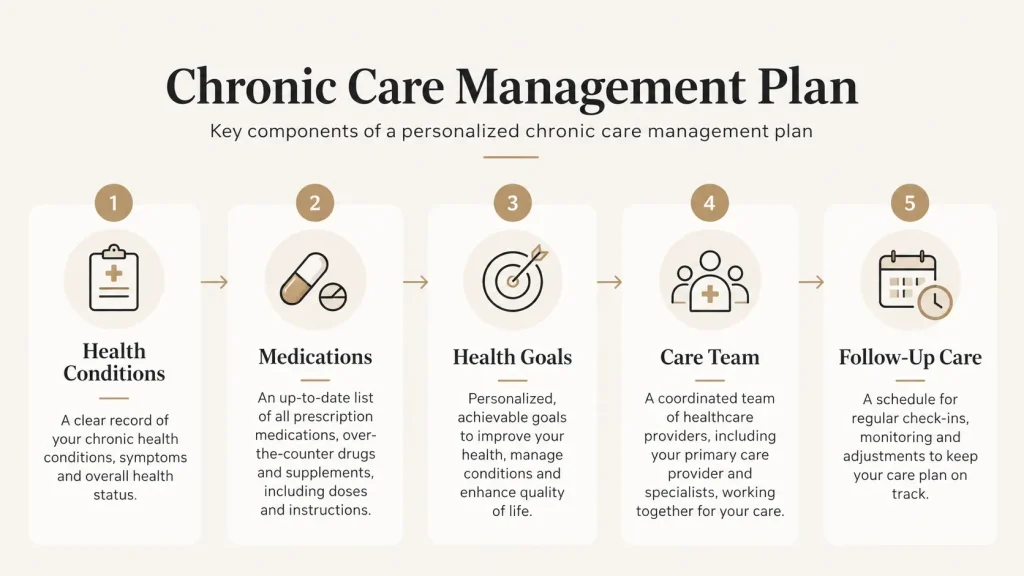
A chronic care management plan is more than an appointment calendar. It documents relevant details for the team, such as healthcare needs and treatment, to enable them to coordinate care. Personalized plan may include diagnoses, symptoms, list of medications, allergies, measurable goals, providers responsible, referrals and community supports.
It can also include information on home monitoring and when to follow up. The team considers the plan for review and revision as needed and not as a document set in stone. Patients and caregivers should be able to obtain relevant plan information. Comprehensive planning is one of the key elements of CCM that is identified in the CMS Care Management Guidance.
How Does Chronic Care Management Work During a Typical Month?
A chronic care management plan is reviewed based on the clinical needs and not a script that is the same for everyone. A typical illustrative monthly process looks like this:
- Review: The team reviews the care plan, health records and any new issues.
- Communicate: Staff can speak to the patient or communicate through an agreed means of communication.
- Coordinate: The team carries out follow up if necessary after prescriptions, specialist information, referral or after a transition in care.
- Update: Relevant changes are recorded and next steps are planned with the patient and clinicians.
It is not always necessary to have an office appointment or a phone call every month. The services and billing requirements depend on the type and amount of qualifying care management performed.
What Conditions Qualify for Chronic Care Management?
Understanding what conditions qualify for chronic care management starts with more than a list of diagnoses. Medicare defines CCM as usually referring to individuals with two or more chronic conditions that will likely last a year or more, or until they pass away, and that cause serious health problems. A clinician takes a holistic view of the overall medical situation, such as what impact this is having on everyday living and whether or not worsening illness is likely.
Who Meets Medicare CCM Eligibility Requirements?
There are three clinical considerations in the main requirements for chronic care management eligibility:
- Multiple conditions: You have at least two ongoing chronic illnesses.
- Expected duration: Those conditions are expected to last at least 12 months or until death.
- Meaningful risk: The conditions put you at significant risk of death, a serious flare-up or deterioration, or loss of function.
CMS also requires an initiating face-to-face visit for a new CCM patient or someone the billing practitioner has not seen within the previous year. This may occur during an appropriate medical visit or Medicare wellness visit. The diagnosis list will not make an individual eligible and the visit that initiated the diagnosis may be billed separately.
Common Qualifying Conditions and Patient Examples
CMS includes diabetes, hypertension, chronic obstructive pulmonary disease (COPD), asthma, arthritis, heart disease, and several other illnesses among possible CCM conditions. The same chronic care management eligibility requirements apply regardless of which conditions a patient has.
For example, A diabetes patient with COPD could require frequent reviews of medications, follow-up of breathing symptoms and a coordination of clinical care. Those needs could support consideration for a program. Traditional Medicare CCM requires at least two chronic conditions, but someone with just one would not meet that requirement. Eligibility should be determined with a participating provider and not by the diagnoses alone.
Does Medicare Cover Chronic Care Management, and What Does It Cost?
Yes. Medicare chronic care management is covered under Part B for eligible beneficiaries when qualifying services are provided. With Original Medicare, you typically are responsible for covering 20% of the Medicare-approved price following the Medicare Part B deductible. This is a portion of an approved charge, not a fixed amount per month for all.
Before enrolling, ask your provider and insurer about:
- Expected charges: Which services may be billed monthly and what you could owe.
- The Part B deductible: Whether you have met it for the year.
- Other insurance: Whether another policy impacts your responsibility.
- Additional services: Bills for office visits, tests and services away from CCM would be separate.
Medicare pays providers a different amount from what is listed on billings to patients. This is dependent on the coverage of the individual, applicable services and rules for Medicare payment.
What Changes With Medicare Advantage or Supplemental Coverage?
For Medicare chronic care management, your insurance arrangements can change the amount you owe even when CCM is medically appropriate:
- Medicare Advantage: Coverage limitations, provider networks and plan-specific copays can impact costs. Look at your plan directly to verify.
- Medigap: A supplemental policy may help with Original Medicare coinsurance or other eligible costs, depending on its terms.
- Medicare and Medicaid: People eligible for both programs may have additional protections. In California, Medi-Cal and Medicare Savings Programs can impact cost sharing, while applicable balance-billing protections are important.
Do not assume that CCM is free or that all Medicaid plans provide the same services. Verify benefits prior to signing up for monthly care management.
Chronic Care Management vs. Chronic Disease Management: What’s the Difference?
The two approaches overlap, but they are not interchangeable.
Chronic care management is a service that is specifically defined in Medicare with eligibility, documented consent, care planning, and monthly billing rules.
Chronic disease management is a wider, continuous treatment of chronic conditions, like diabetes or high blood pressure. This can include appointments, monitoring, medication adjustments, lab testing, referrals and more, even if there is no formal CCM program in place.
| Feature | Medicare CCM | Chronic Disease Management |
| Purpose | Coordinate ongoing care under Medicare CCM rules | Treat and monitor chronic health conditions |
| Eligibility | Two or more qualifying conditions and other CCM requirements | Based on individual medical needs |
| Services | Care plan, coordination, monthly qualifying care management | Visits, monitoring, medication adjustments, testing, and referrals |
| Payment | Separate Medicare care-management billing rules | Depends on services and insurance arrangements |
| Consent | Specific documented CCM consent requirements | Consent appropriate to ordinary healthcare services |
Medicare also has Principal Care Management (PCM) for some patients with one complex, high-risk condition. It has different requirements from CCM.
Patients Choice Clinic’s Chronic Disease Management Services are based on ongoing, personalized care for chronic conditions. If you’re thinking about enrolling in a formal Medicare CCM program, be sure to check with the provider that offers the program to verify enrollment qualifications, and how the program gets paid.
What Should Patients Consider Before Starting CCM?
A CCM program can help you find it easier to navigate the system of ongoing care, but it’s important to know what you’re signing up for. Consent is needed prior to billing for chronic care management services. CMS will accept written or verbal consent, as long as it can be documented, and your provider should discuss costs and participation.
Before enrolling, consider these points:
- Who is taking care of you? Know the practitioner responsible for the CCM program and how other specialists are involved.
- How will you communicate? Inquire on the manner in which regular questions are dealt with and the way the team responds to pressing issues after hours.
- What might you pay? Ask for an estimate of monthly cost-sharing and if they charge separate bills for visits or testing.
- What support can you expect? Find out how you receive your care plan and what follow-up is appropriate for your conditions.
- What are your rights? Only one practitioner may provide and bill CCM in a calendar month. You may stop participation at any time, effective at the end of that month.
CCM supports medical care, but is not a substitute for routine checks or emergency care. Consider using a qualified provider to discuss the pros and cons before making a decision.
Frequently Asked Questions About Chronic Care Management
These are answers to some of the billing, coverage, and participation questions that may come up when thinking about continuing care support.
How Much Does Medicare Pay for Chronic Care Management?
Medicare’s payment to the healthcare provider depends on the CCM service billed and applicable payment rates. There is no fixed reimbursement per month for every patient. To estimate your out-of-pocket costs, ask about the Medicare approved amount and insurance coverage.
Does Medicaid Pay for Chronic Care Management?
Medicaid benefits vary by state and plan. Those with Medicare and Medicaid might receive Medicare coverage for qualifying CCM, and Medicaid can impact cost sharing. In California, eligible Medi-Cal members have important protections against improper Medicare cost-sharing bills. Check your specific eligibility and plan benefits.
Can You Stop Chronic Care Management Services?
Yes. Under CMS rules, you can withdraw from CCM at any time, with the change effective at the end of the calendar month. Inform the practitioner in charge of your enrollment, ask whether any charges remain, and arrange routine care.
Do You Need an Office Visit Every Month for CCM?
No. CCM usually involves care management outside office visits, so a face-to-face appointment is not automatically required each month. However, Medicare requires an initiating visit for new patients or patients the billing practitioner has not seen in the previous year. Regular medical visits remain important.
Can Two Healthcare Providers Bill for CCM in the Same Month?
No. CMS permits only one practitioner to provide and bill CCM for a patient in a calendar month. Multiple clinicians may still be seen for routine medical care. Tell your care team if another practice has already enrolled you in CCM to prevent duplicate billing.
Can You Qualify for CCM With Only One Chronic Condition?
Traditional Medicare CCM requires two or more qualifying chronic conditions. If you have one severe, complicated medical condition, you may want to consider Principal Care Management. The length of coverage, duration of service, risk, and eligibility requirements are unique to PCM and not covered by one diagnosis.
Where Can You Find Ongoing Chronic Disease Care in Burbank?
It is easier to manage a long-term health condition when there is a plan for treatment and someone with medical knowledge is managing your health history. Even if you don’t qualify for Medicare CCM, long-term medical follow-up is beneficial.
At Patients Choice Clinic, we provide Primary Medical Care and personalized chronic disease management in Burbank, including medication reviews, appropriate testing, monitoring, and follow-up for conditions such as diabetes and high blood pressure. We can talk about your current worries, your current care requirements and what treatment options are available.
Contact Us to Discuss Chronic Disease Management in Burbank. Book your Consultation or call us at (818) 514-0902 to get started.