
Fine lines that appear beneath your eyes when you smile can be frustrating. You may wonder whether Botox for under-eye wrinkles can soften those lines without changing your appearance.
Botox can help reduce some wrinkles that are a result of muscle movement, but it is important to be aware of the location. Treating crow’s feet around the outer corners of the eyes differs from injecting directly beneath the lower eyelids. The first has an FDA-approved cosmetic indication; the second is an off-label use with additional considerations. Knowing this distinction can aid in making decisions regarding expectations and safety.
Can Botox Treat Under-Eye Wrinkles?
Yes, Botox may help reduce some wrinkles around the eyes caused by muscle movement. But not all lines under the eyes will be corrected. Treatment may be appropriate depending on the cause and location of your wrinkles.
Crow’s Feet vs. Botox Directly Under the Eyes
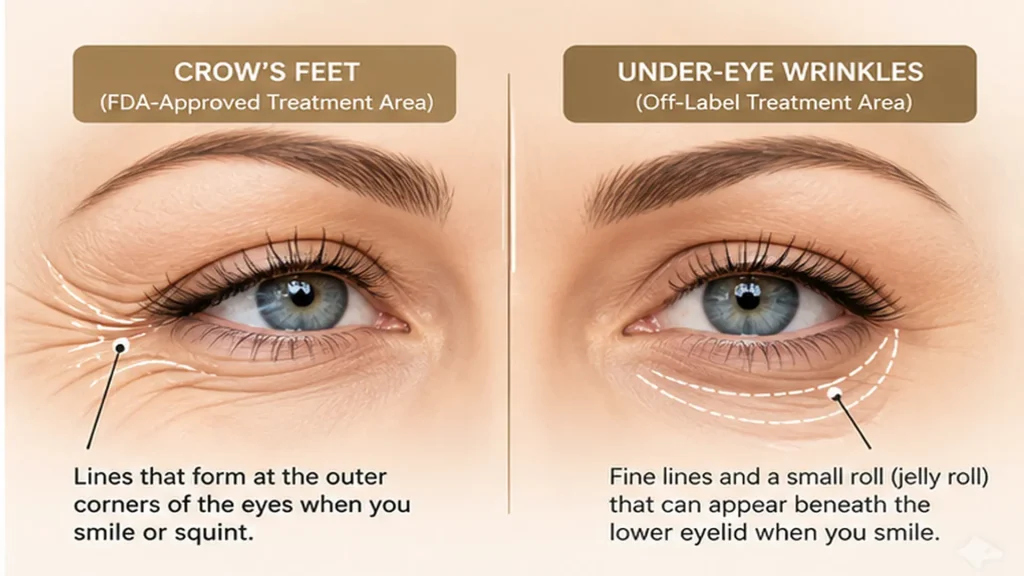
Crow’s feet are lines that spread outward from the eye corners when you smile or squint. BOTOX Cosmetic is FDA-Approved to temporarily improve moderate-to-severe lateral canthal lines, the medical term for crow’s feet, in adults.
Instead, direct under-eye Botox injections are used in the lower eyelid area. Direct lower-eyelid injections are not an FDA-approved cosmetic indication for BOTOX Cosmetic and are off-label.
A small roll that forms just beneath the lashes during smiling is sometimes called a “jelly roll.” Treating this area is not the same as treating crow’s feet. The lower eyelid also plays a protective role on the eye, and careful evaluation is crucial.
How Botox Works on Dynamic and Static Wrinkles
Botox belongs to a group of medicines called neuromodulators. It temporarily reduces nerve signals that tell certain muscles to contract. The orbicularis oculi muscle encircles the eye and is responsible for creating facial expressions and eyelid movements.
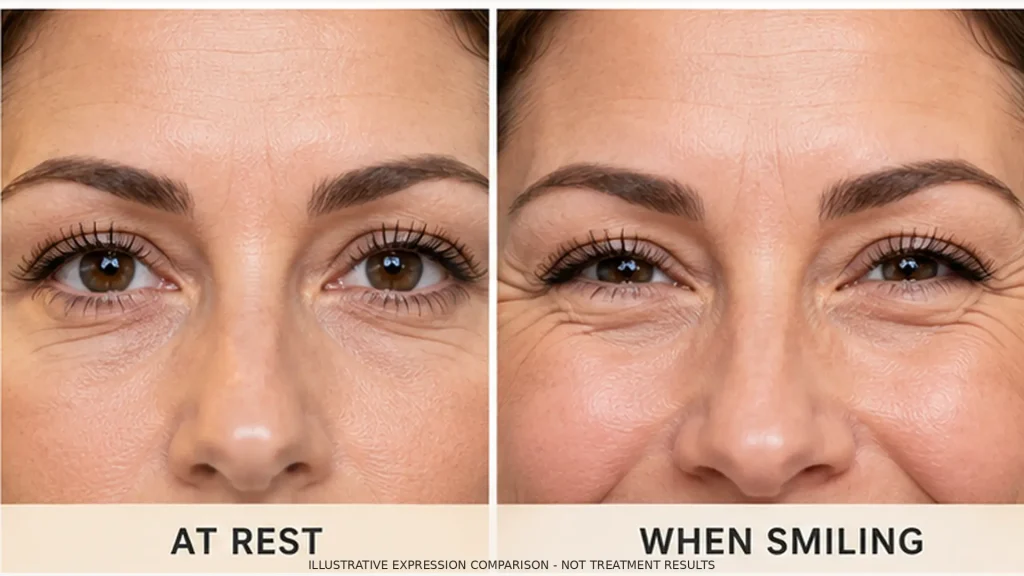
Dynamic wrinkles appear mainly during muscle movement, while static wrinkles remain visible when your face is at rest.
For example, fine lines may appear near the corners of your eyes when you smile. Some disappear when you stop smiling, while others remain. Botox can help diminish appropriate movement lines, but it can’t reliably remove lines that are a result of skin thinning, sun damage, or a decrease in elasticity.
Who May Benefit from Botox Around the Eyes?
The right candidate depends on facial movement, skin condition, eyelid support, medical history, and the exact treatment area.
Can Botox Help Under-Eye Wrinkles When Smiling?
Botox for under-eye wrinkles when smiling may help in selected situations because smiling activates muscles around the eyes. Crow’s feet may improve with FDA-approved treatment, while injections under the lower lid need to be evaluated individually.
A healthcare professional may check for:
- Expression-related lines: Wrinkles appearing mainly during smiling or squinting.
- Wrinkle location: Lines are either at the outer corners or below the lashes.
- Lower eyelid condition: Any dryness, looseness or puffiness of the lower eyelids that could impact treatment.
The aim is to soften suitable wrinkles while maintaining natural expression and eyelid movement.
When Botox May Not Help: Eye Bags, Dark Circles, and Crepey Skin
Searches for Botox for baggy eyes often describe concerns that muscle-relaxing injections cannot directly resolve.
Fullness under the eyes: Fluid retention, visible fat pads and excess tissue can cause eye bags. Botox does not address these causes and may accentuate existing puffiness in some patients.
Dark Circles: Pigmentation, shadows, visible blood vessels, and hollows can contribute to darkness. Botox does not directly correct these concerns.
Fine crepey skin: Thin, bumpy skin and decreased elasticity can result in fine creases even when the face is relaxed. Some improvement may be seen with Botox.
Under eye hollows: Loss of volume results in shadows under the eyes. Facial muscle relaxation will not create lost volume.
Botox for Under-Eye Wrinkles Before and After: What to Expect
Botox for under–eye wrinkles before and after photographs are most useful when they show the same facial expression, treatment area, lighting, and camera angle. Realistic results will vary based on the type of wrinkles and the treatment that was done.
What Realistic Before-and-After Results May Show
With proper treatment, crow’s feet can be less noticeable when you smile, and your eyes can still move normally with it. The fine lines might not be erased, but may appear softer.
Folds that can be seen at rest, deeper folds and crepey skin may not change as much. There are also variations in results based on anatomy, skin type and individual response.
For example, consider someone whose outer-eye lines become noticeable whenever they smile. Those lines could look less severe in a subsequent smiling picture after appropriate crow’s-feet Botox treatment.
However, their dark circles, tear-trough hollows, and lower-eyelid puffiness could remain unchanged. This is an illustrative example, not a claimed patient result.
Changes in under-eye fullness may involve fillers, surgery, or other treatments rather than Botox alone.
How to Compare Before-and-After Botox Photos Correctly
Search results for Botox around eyes before and after can include crow’s-feet treatment, direct lower-eyelid injections, and combinations of cosmetic procedures.
When reviewing photographs, check the following:
- Facial expression: Make comparisons between smiling and smiling and resting and resting.
- Lighting: Different shadows may hide or exaggerate fine lines.
- Camera angle: Position and distance can change how eye bags and wrinkles appear.
- Treatment timing: The photographs should identify when the results were recorded.
- Procedures performed: Identify if Botox was used alone or in combination with fillers or resurfacing or surgery.
A reliable comparison should avoid digital smoothing and identify the treatment area. Confirm that the photos show real patients rather than computer-generated results.
Under-Eye Botox Results: Timeline and Longevity
Under eye Botox results develop gradually rather than immediately. Established timelines describe approved cosmetic uses, such as crow’s feet, rather than direct lower-eyelid injections.
When Do Under-Eye Botox Results Appear?
Many patients see improvements after receiving botulinum toxin within three to seven days, according to the American Academy of Dermatology.
The effect is still maturing and a clinician can evaluate the response approximately two weeks after therapy.
| Treatment stage | Approximate timeframe | What you may notice |
| Immediately afterward | First 1–2 days | Wrinkle improvement may not yet be noticeable. |
| Early response | Around days 3–7 | Movement-related lines may begin softening. |
| Follow-up assessment | Around 2 weeks | Your clinician can assess the developing response. |
| Gradual wearing off | Often months 3–4 | Muscle activity returns and lines may reappear. |
These are general expectations for a regular cosmetic botox treatment. There is no guarantee for the timeframes of direct lower eyelid injections.
How Long Does Under-Eye Botox Last?
Patients often ask, “How long does under eye Botox last?” The answer depends partly on which eye-area treatment is being considered.
The American Society of Plastic Surgeons reports that the effects of FDA-approved cosmetic procedures, like crow’s feet, usually last for around 3 to 4 months.
Muscle movement returns and expression lines become more visible, as the medicine fades with time.
The length of time for improvement will depend on individual response, facial anatomy, and treatment planning. Direct lower eyelid injections have less evidence available, and the same length of time cannot be guaranteed.
Follow-up consultations can assist in determining if further treatment is needed.
What Happens During an Eye-Area Botox Consultation and Treatment?
The lower eyelid is especially significant when a consultation is needed, as opposed to the outside of the eye corner.
Before Treatment: Medical History and Eye-Area Assessment
Before considering Botox for the eye area, it’s best to see a qualified clinician to examine the function of your eyelids, facial movements, and your skin.
Expect questions about:
- Eye symptoms: Dryness, irritation, inability to close eyes or eyelids that have drooped before.
- Previous procedures: Eyelid surgery, previous injections, or other treatments in the eye area.
- Medical history: Neuromuscular conditions, allergies, medications, and supplements.
- Pregnancy or breastfeeding: Safety information is limited, so notify of pregnancy and discuss deferral.
A comprehensive evaluation will determine potential concerns that can affect risk. Do not stop prescribed medication without guidance from your prescribing clinician.
During Treatment and Aftercare: What to Expect
A typical appointment consists of four steps when Botox is indicated for the treatment area.
- Consultation and consent: Your clinician explains the proposed treatment, its benefits, possible side effects, alternatives, and cost.
- Treatment: A trained, licensed medical professional administers the prescribed product. There may be brief pinches at the site of injection.
- Aftercare: Follow your provider’s instructions. Do not rub or massage treated areas, and carefully apply makeup, if allowed.
- Follow-up: Contact your provider about unusual symptoms or unexpected results and attend any recommended assessment.
Specific aftercare advice may vary according to your treatment and medical history.
Is Under-Eye Botox Safe? Side Effects and Possible Complications
Botox has proven its cosmetic value, but close-up injections around the eyes must be carefully screened. There are risks associated with direct treatment of the lower eyelid.
Common Botox Side Effects and Warning Signs
Like other injectable medicines, Botox around the eyes can cause side effects even when administered appropriately.
- Common short-term reactions: There may be some swelling, tenderness, redness or bruising around the injection site. These reactions are usually short-lived.
- Symptoms that need urgent medical examination: New eyelid drooping, asymmetry, persistent eye irritation, worsening dryness, or an inability to close an eye requires medical evaluation. Seek urgent medical attention for eye pain or vision changes.
- Emergency warning signs: BOTOX Cosmetic has an FDA boxed warning for possible spread of toxin effects outside the area of injection.
If breathing, swallowing, or speaking becomes difficult after treatment, or you develop significant generalized muscle weakness, seek emergency medical care.
Why Direct Lower-Eyelid Botox Needs Extra Caution
Off-label under-eye Botox is not simply a smaller version of crow’s-feet treatment.
Muscles around the lower eyelid help the eyelid to blink, close, and move in their normal position. Loosening these muscles in an inappropriate condition can impact the comfort and look of the eyes.
There are some concerns in clinical research:
- Dryness or incomplete eye closure: Inability to close eye sufficiently may result in inadequate protection of the eye surface.
- Lower-eyelid position changes: Eyelid may rest abnormally or in some instances, may be turned outward called ectropion.
- More noticeable puffiness: Existing fat pads or loose skin may become more prominent if muscle support changes.
- Pre-existing conditions: Some risks may be higher if you have dry eyes, loose skin at the bottom of your eyes or if you have had eyelid surgery.
When contemplating off-label use, the benefits, limitations, and alternatives should be explained by an experienced clinician.
Under-Eye Botox Cost in Burbank: What Affects the Price?
Under eye Botox cost depends on your treatment goals, facial anatomy, and the number of units recommended. At Patients Choice Clinic, Our Botox Treatments start at $12 per unit, with final pricing based on your individual treatment plan.
Several factors can affect the Under-Eye Botox Cost in Burbank:
- Treatment area: Crow’s feet and fine lines just under the eyes are different and need to be treated differently.
- Number of units: The recommended dose depends on your muscle movement, facial anatomy, and desired results.
- Individual assessment: You will have your concerns assessed to see if Botox is right for you.
Botox may not work for everyone and the skin under your eyes is delicate. During your consultation, we’ll discuss appropriate treatment options, confirm availability, and explain the expected costs before you proceed.
If Botox Isn’t Right: Alternatives for Under-Eye Concerns
Treatment will depend on the problem that you have from facial movement, skin texture, pigmentation or lost volume and puffiness. Certain conditions are better treated with skin care treatment or by a specialist rather than injections.
| Under-eye concern | Can Botox help? | Treatment approach to discuss |
| Expression-related crow’s feet | May soften suitable lines | FDA-approved crow’s-feet treatment for eligible adults. |
| Static lines or crepey skin | Benefits may be limited | Topical skin care or clinician-assessed resurfacing. |
| Under-eye hollows | Does not restore volume | Specialist evaluation; discuss filler risks. |
| Eye bags or puffiness | Does not remove fat or fluid | Assessment of underlying causes and possible specialist care. |
| Dark circles | Does not correct pigmentation | Cause-specific skin care or dermatology evaluation. |
Our Microneedling with PRP service addresses general skin-texture concerns. But it is necessary to make a clinical judgement about treatment suitability in the immediate vicinity of the sensitive area of the lower eyelid.
Dermal filler injections around the eyes carry important risks. The FDA recommends against filler injections in the periorbital area, which is not an approved filler injection site, and warns of rare but serious complications, including vision loss.
A qualified specialist can help you understand which treatments are appropriate for your concerns.
Frequently Asked Questions About Under-Eye Botox
Here are answers to other common questions about eye-area Botox treatment.
Is jelly roll Botox different from crow’s-feet Botox?
Yes. The “jelly roll” is a small fold underneath the lower lashes, and the crow’s feet are folds at the outside corners of the eyes. Botox can be used for cosmetic indication of crow’s feet. Lower-eyelid injections are off label and should be used with caution.
Can Botox around the eyes change your smile?
It can. Relaxing the muscles surrounding the eyes can alter how wrinkles look during smiling. Treatment not appropriate to your anatomy can also impact expression. A trained clinician is looking for natural-looking results, but none can guarantee that the face will not move.
Can I consider eye-area Botox after eyelid surgery?
Possibly, but some tissue support and eyelid closure may have been compromised by previous eyelid surgery. Tell your clinician which procedure you had and when. A careful evaluation of your eyelid position, eye comfort, and healing is necessary before considering further treatment.
Can I wear makeup after Botox around the eyes?
The American Academy of Dermatology shows that you can wear make-up after botox application, but make sure you do not rub or press the botox injection area. Follow your clinician’s instructions and use gentle application, especially if your skin feels irritated.
How do I choose a qualified injector for the eye area?
Review provider’s professional licensure, facial anatomy training, experience in treatment of the area, and complications management. Inquire if the suggested treatment is FDA-approved or off-label. There should be a clear description of risks, benefits and alternatives.
What if my Botox results look uneven?
Contact the clinician who performed your treatment. Botox works over time, so assessing symmetry right away may not be accurate. Your provider can see the changes and help you decide what to do next. Do not have unplanned corrective injections without a proper medical examination.
Can Botox be combined with other under-eye skin treatments?
Sometimes. Various treatments can target different issues, such as wrinkles in the face and skin texture. But there are some extra factors to consider when you combine procedures. A qualified clinician should assess your skin, explain the risks, and determine whether the proposed combination is appropriate.
Considering Botox Around Your Eyes? Talk With Patients Choice Clinic
Botox may soften certain expression lines, particularly crow’s feet, but the best decision starts with understanding what causes your under-eye concerns. Fine lines, eye bags, dark circles and skin laxity are all very different and will react differently. A careful evaluation helps establish realistic goals and avoid unnecessary treatment.
At Patients Choice Clinic in Burbank, we offer Botox consultations and treatment for areas including crow’s feet. We can listen to your concerns, explain suitable options, and confirm which treatments are available.
Request a Botox Consultation or call us at (818) 514-0902 to get started.