
Explore non-surgical facial rejuvenation with Botox, fillers, microneedling, IPL, laser, and more at Patients Choice Clinic.
Non-surgical facial rejuvenation can address wrinkles, facial volume changes, uneven texture, pigmentation, and other signs of skin aging without traditional facial surgery.
The important thing is to select the treatment based on the concern. Botox and fillers and microneedling and IPL and fractional laser all do different things, so one of these cannot fix all facial changes.
Common non-surgical facial rejuvenation treatments include:
- Neuromodulators (such as Botox) for movement-related lines.
- Selected volume and contour concerns dermal fillers
- Microneedling for Skin Texture and Collagen Remodelling.
- IPL treatment for pigmentation & redness.
- Fractional laser resurfacing for texture, lines and targeted scars
A good treatment plan begins with why a concern is occurring, not with the treatment that is popular.
What Is Non-Surgical Facial Rejuvenation?
Non-surgical facial rejuvenation refers to any cosmetic treatment that enhances the mobility, volume, contour, tone and texture of the face without surgical lifting.
These treatments work in different ways:
- Muscle related treatment: Neuromodulators like Botox help diminish muscle activity in a targeted area that leads to expression lines.
- Volume related treatment: Dermal fillers are used to provide support or volume to specific sections of the face.
- Texture-related treatment: Microneedling and fractional laser treatments encourage rejuvenation and enhance targeted texture issues.
- Pigment related treatment: IPL or other suitable energy treatments can be used to treat particular brown spots, redness and uneven tone.
Facial rejuvenation without surgery does have limits. Injectable or skin procedures can often not fully correct significant skin lack or structural changes.
Note: A treatment that is “non-surgical” does not mean it is an option to be taken lightly. Medical history, facial anatomy, skin type, previous treatments, and realistic goals still matter.
How Does Botox Fit Into Facial Rejuvenation?
Botox helps with facial rejuvenation treatments by temporarily lowering the activity of specific facial muscles that cause or deepen facial lines when used repeatedly for facial expressions.
Movement-related wrinkles typically develop in facial areas that often move when you smile, frown, squint, or raise your eyebrows.
Botox may be considered for:
- Forehead lines: These are partly formed as a result of repeated use of the forehead muscle.
- Frown lines: When the vertical lines between the eyebrows contract over time on the face, they can become more prominent.
- Crow’s feet: Smiling and squinting can contribute to lines around the outer eyes.
- Other chosen expression lines: treatment will depend on facial movement, anatomy and desired treatment.
Botox does not add volume back to the skin or give it a new look. It’s significant to know the difference between Botox and fillers, microneedling or laser treatments.
At Patients Choice Clinic, our Botox treatment information outlines how we evaluate the face and plan treatment accordingly.
Which Treatment Is Used for Which Facial Concern?
The best way to compare non-surgical cosmetic treatments is to get a handle on what the concern is and then finding an appropriate treatment category.
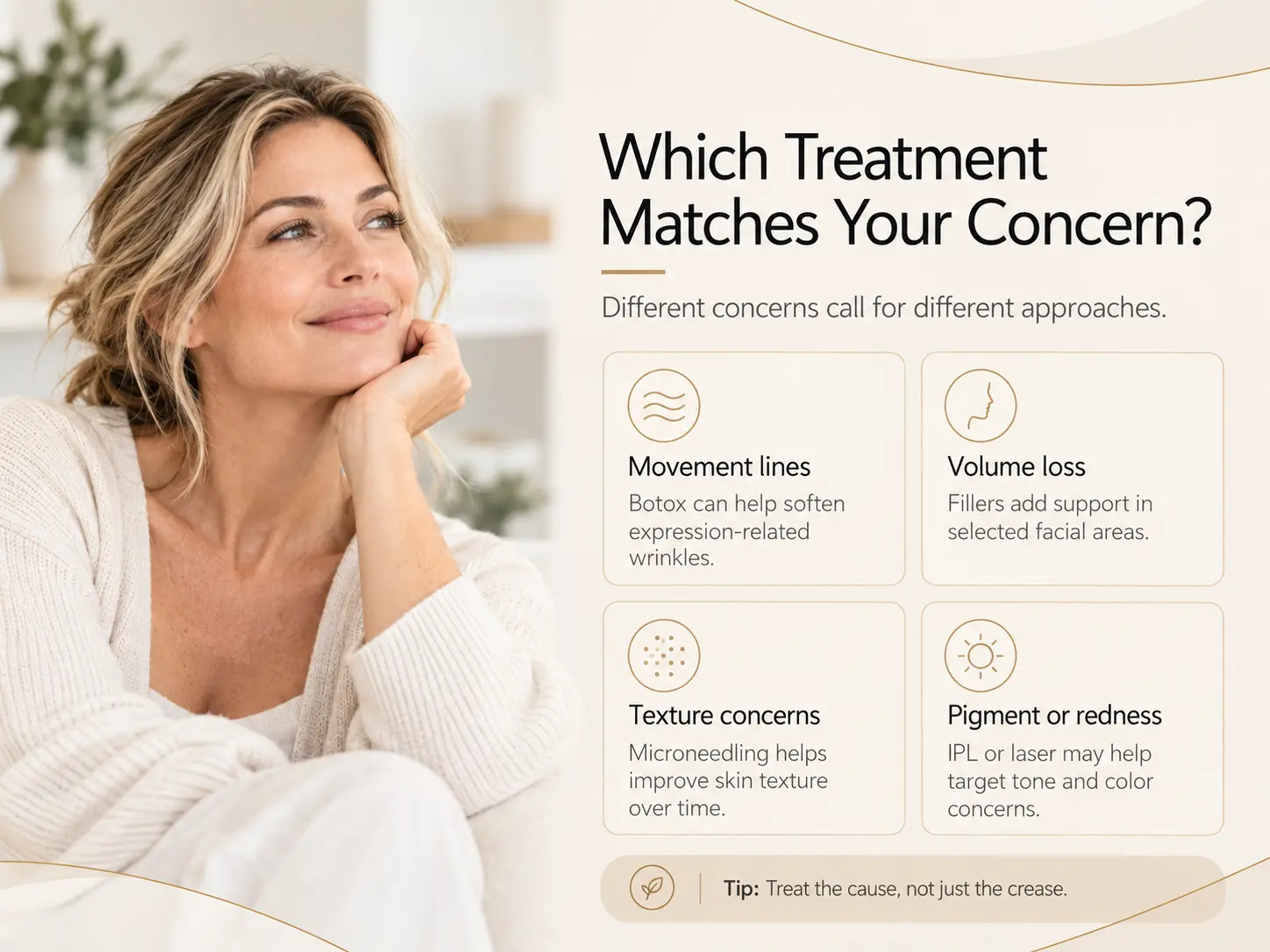
A visible line is not a diagnosis by itself. Different approaches are required by two individuals with the same line due to differences in facial anatomy as well as the different causes.
| Facial Concern | Common Cause | Treatment That May Be Considered | Main Goal |
| Forehead or frown lines | Repeated muscle movement | Botox or another neurotoxin | Reduce targeted movement |
| Facial volume changes | Changes in facial support | Dermal filler | Restore selected support or contour |
| Smile lines | Anatomy, volume, fold depth | Filler or broader facial assessment | Soften or support the area |
| Rough texture | Skin and collagen changes | Microneedling or fractional laser | Improve texture |
| Acne scars | Structural skin changes | Microneedling or laser | Support remodeling |
| Brown spots | Pigmentation | IPL or appropriate laser | Improve selected pigment |
| Facial redness | Vascular color changes | Appropriate IPL treatment | Reduce selected redness |
| Nasal contour concerns | Shape and proportion | Non-surgical rhinoplasty | Adjust selected contours |
How Do Dermal Fillers Help Smile Lines?
Although dermal fillers can help to smooth out some facial wrinkles, specifically facial creases, good dermal filler treatment planning takes into account the other structures and facial anatomy before filling a crease.
The nasolabial folds extend from the sides of the nose to the corners of the mouth. These folds are an integral component of the face and can vary in depth in a normal way.
There are a number of factors that can affect their visibility:
- Natural anatomy: Some individuals have more robust folds whether young or old.
- Facial volume: Volume changes in the middle face may affect the appearance of the fold.
- Skin quality: Collagen alteration can affect the definition of a crease, as can skin thickness.
- Facial movement: Repeated facial movement and smiling help the area to fold.
- Fold depth: Fine and deeper folds might need treatment thinking.
Direct Filler Vs. Midface Support
Filling a fold directly does not necessarily mean it is the right way.
- Direct treatment: Careful placement of filler within or around selected folds may be beneficial.
- Midface support: Some people have changes higher in the cheek that contribute to the appearance of the lower fold. Supporting that area may occasionally be included in the plan.
- Any combination: Some cases may be best served by treating both facial support and the crease itself.
Our dermal filler service page details the areas we evaluate when considering dermal filler treatment options on the face.
What Does Filler Look Like Right After Treatment?
Early filler results should not always be treated as the final settled appearance.
Temporary changes may include:
- Swelling
- Tenderness
- Redness
- Bruising
- Slight temporary irregularities due to swelling.
Initial volume may become apparent sooner rather than later, but appearance typically can be assessed more easily once the temporary post-treatment changes have settled.
Hint: Do not rely on a photo taken only after the filler. The settled result, as well as the angle, lighting, swelling and facial movement, all give greater context.
Where Does Microneedling Fit Into Facial Rejuvenation?
Microneedling promotes non-surgical skin rejuvenation by promoting the skin’s repair response and natural collagen re-modelling in a controlled manner by creating microchannels.
The technique is not meant to correct facial muscle movement or large amounts of volume loss.
Microneedling may be considered for:
- Uneven texture: Helps support smoother-looking skin through remodeling.
- Acne scars selected: Gently injuring the skin can help it improve over time.
- Fine surface lines: Collagen remodeling may improve the appearance of some fine lines.
- Enlarged-looking pores: Overall texture improvement can make pores appear less noticeable.
- General skin quality: If texture is the primary concern and not face structure, then treatment can be provided.
Our microneedling and PRP service page outlining the options currently available at Patients Choice Clinic.
When Is Laser or IPL Skin Rejuvenation a Better Fit?
Laser and IPL treatments are included in the non-invasive facial rejuvenation category if the primary issue is skin tone, pigmentation, redness, texture, fine lines or targeted scars.
IPL and fractional laser are not identical and therefore depend on which we are trying to improve.
- IPL: This is usually taken into consideration when the main concern is color, whether it be selected brown areas, sun-related pigmentation, visible redness or uneven tone.
- Fractional laser: These are typically recommended for texture issues, fine surface lines, specific acne scars, larger appearing pores or collagen remodeling concerns.
- Skin assessment: Before choosing an energy based treatment, the skin tone and pigmentation history, active irritation, sun exposure and previously applied treatments should be taken into account.
Our laser aesthetics services provide several technologies, such as IPL and fractional laser options, at patient choice clinic.
Can Facial Rejuvenation Treatments Be Combined?
If there are multiple cosmetic concerns, it may make sense to use more than a single non-surgical facial rejuvenation treatment, but adding more procedures doesn’t necessarily mean better results.
A treatment plan may focus on multiple facets of the concern at different times.
- Movement + volume: Botox will treat expression lines, while filler will treat specific loss of facial support.
- Pigment + texture: IPL can help treat specific discoloration and microneedling/fractional laser helps for texture.
- Injectables + skin treatment: Sometimes a patient may have a skin quality concern and a facial contour concern that can be addressed in a single plan.
Treatment needs to be tailored to the individual. A number of factors affect appropriate sequencing, including skin recovery, swelling, prior procedures and treatment type.
How Do You Know Which Facial Rejuvenation Treatment Is Right for You?
Deciding between facial rejuvenation procedures begins with clarifying the concern, desired outcome, recovery timeframe, facial structure, skin type and medical history.
Useful factors include:
- The primary concern: To decide if the focus is on moving, on volume, on pigment, on texture, on scars, or on more than one of these.
- Causes for concern: A moving forehead line will need different thought than a static forehead line or rough skin texture.
- Desired amount of change: Some people want a subtle improvement while others are trying to address a more noticeable concern.
- Downtime preference: There are different experiences of recovery for injectables and skin procedures.
- Previous treatment: Previous filler, Botox, laser or other treatments may impact treatment planning.
Skin types: Skin tone, sensitivity, pigmentation history and current skin condition may impact suitability of procedures.
How Do the Main Facial Rejuvenation Treatments Compare?
Comparing the primary purpose of facial rejuvenation treatments is more helpful than attempting to find a single “best” procedure, since different rejuvenation methods address unique problems.
Multiple types of concerns can exist on the same face. Moving, structuring, pigmentation and skin quality should be evaluated independently, to clarify treatment decisions.
| Treatment | Often Considered For | How Results Develop | Common Downtime Considerations | Does Not Primarily Treat |
| Botox / neurotoxins | Movement-related lines | Develop gradually | Injection-site redness or bruising may occur | Facial volume loss |
| Dermal fillers | Volume, contours, selected folds | Initial change may be immediate; swelling settles later | Swelling or bruising may occur | Pigmentation |
| Microneedling | Texture, scars, collagen remodeling | Progressive | Temporary redness and sensitivity | Significant volume loss |
| IPL | Selected pigment and redness | Progressive | Temporary redness or darkening of treated pigment may occur | Facial volume |
| Fractional laser | Texture, fine lines, selected scars | Progressive | Depends on treatment intensity | Muscle-driven lines |
| Non-surgical rhinoplasty | Selected nasal contours | Initial contour change may appear quickly | Swelling or tenderness may occur | Functional or major structural nasal problems |
Side Effects and Risks of Non-Surgical Facial Rejuvenation
All non-surgical facial rejuvenation procedures have potential side effects, which vary according to treatment type, area, technique, skin condition, and individual response.
Good treatment planning includes understanding the expected recovery as well as less-common complications before deciding to proceed.
Botox and Neuromodulator Side Effects
Depending on the site of the treatment and the patient, there may be temporary reactions at the injection site and/or undesirable effects on adjacent muscles.
Possible effects include:
- Temporary redness
- Bruising
- Tenderness
- Headache
- Temporary asymmetry
- Unwanted weakness of nearby muscles
The facial assessment and careful planning of treatment minimize unnecessary complications.
Dermal Filler Side Effects and Risks
Facial rejuvenation treatments with dermal filler may have temporary local reactions, and less common complications should be promptly evaluated and managed clinically.
Potential concerns include:
- Swelling
- Tenderness
- Bruising
- Redness
- Lumps or irregularities
- Infection
- Inflammatory reactions
- Blood-vessel complications
A good knowledge of the anatomy of the face is especially critical for the injector as each area and individual has different blood vessels.
Microneedling Side Effects
For non-surgical skin rejuvenation, microneedling temporarily disrupts the skin barrier and it is essential to consider treatment depth, skin assessment, skin hygiene and after care.
In the short-term, common side effects include:
- Redness
- Tightness
- Mild swelling
- Tenderness
- Dryness or sensitivity
If the skin is irritated or infected, or if it is very irritated, it may be advisable to delay treatment until the skin has recovered.
Laser and IPL Side Effects
Non-invasive facial rejuvenation through laser or IPL may temporarily alter the appearance of the skin regarding colour, sensitivity or inflammation, depending on skin type and treatment strength.
Possible effects include:
- Redness
- Swelling
- Temporary sensitivity
- Crusting
- Changes in pigmentation
- Not effective or too harsh if burns or long term irritation occurs
Pigmentation history, recent sun exposure, skin type and current skin condition should be taken into account prior to treatment.
How Does Non-Surgical Rhinoplasty Fit Into Facial Rejuvenation?
Non-surgical rhinoplasty involves carefully placing dermal filler to modify specific areas of the nose and nose shape without the need for surgical rhinoplasty.
It may be considered when someone wants to improve:
- Minor contour variations: Filler can be used to take up minor dips or rough spots.
- Profile balance: Strategic placement can change how the nasal profile appears.
- Bridge definition: Filler can add support in selected areas.
- Facial harmony: Small contour changes may improve how the nose relates visually to nearby facial features.
Non-surgical rhinoplasty does not shrink the nose or create the same changes in the structure as a surgical procedure. It is also not appropriate for every nasal concern.
Who May Need to Delay or Avoid an Aesthetic Treatment?
For some, there are skin conditions, medications, health history, or current situations that may require the treatment to be modified, postponed or avoided as a non-surgical cosmetic procedure.
Factors worth discussing include:
- Active skin issues: Infection, open lesions or severe skin inflammation near the treatment area may need to be treated first.
- Previous reactions: Discuss any previous issues with the use of injected products, lasers, adhesives, numbing products or other aesthetic procedures.
- Medications & supplements: Some of these may have an impact on bruising, healing or suitability for treatment.
- Medical conditions: Some medical conditions can affect the way a procedure is approached.
- Recent aesthetic treatment: If an aesthetic treatment has been previously performed such as filler or recent skin procedure which may impact the timing of a further treatment.
- Pregnancy or breastfeeding: Elective treatment decisions should be discussed individually with an appropriate healthcare professional.
What Should You Ask Before Choosing a Facial Rejuvenation Provider?
Choosing a provider for facial rejuvenation without surgery should involve more than comparing prices, social-media photos, or the number of treatments offered.
Useful questions include:
- Who is providing the treatment? Know the credentials and experience of the person carrying out the procedure.
- What is the reason for this treatment? The explanation should connect the procedure to your actual concern.
- What are the alternatives? Good decision-making includes understanding other reasonable options.
- What is the product or device that is being used? It’s important to know what treatments are involved.
- What recovery should I expect? Inquire about normal redness, swelling, bruising, sensitivity, and other issues related to aftercare.
- What happens if there is a problem? Follow up and complication management in the context of esthetic healthcare.
- What is a reasonable answer? A helpful consultation should establish reasonable expectations, and not guarantee a dramatic or guaranteed outcome.
Facial Rejuvenation in Burbank: What Options Are Available at Patients Choice Clinic?
When it comes to facial rejuvenation in Burbank, we begin by listening to your concern instead of defaulting to Botox, the filler, microneedling, IPL or other treatments.
People searching for aesthetic treatments Burbank often arrive knowing the result they want but not which type of treatment fits the cause.
Relevant options we provide include:
- Botox and neurotoxins: For specific lines of the face that move.
- Dermal fillers: For appropriate volume, contour, and fold concerns
- Microneedling: When there are specific texture and skin-quality issues
- PRP microneedling: Another individualized skin-rejuvenation option.
- IPL: Treatment for pigmentation and redness conditions.
- Fractional laser treatments: For selected texture, fine-line, pore, and scar concerns
We don’t have to use all the treatments when there are multiple treatments. It is better to determine if the primary problem is with movement, volume, skin texture, pigmentation or a combination of these.
Frequently Asked Questions About Non-Surgical Facial Rejuvenation
Many questions concerning non-surgical facial rejuvenation procedures involve the use of multiple procedures, recovery and maintenance, and what an individual can expect from non-surgical facial rejuvenation procedures.
Can facial rejuvenation without surgery replace a facelift?
Certain wrinkles, volume issues, pigmentation and skin texture can be enhanced with non-surgical procedures. If there is a significant laxity or tissue descent, there is a need for a different approach, as injectables and skin treatments cannot replicate the effect of surgery.
Can I treat more than one facial concern?
Yes. Support and movement, facial texture and texture, pigmentation and pigmentation—separate concerns, different treatments in an individualized plan.
Should Botox or filler be used for smile lines?
It depends on the cause. Botox is primarily used to treat muscle activity and filler can help to support certain folds or volume deficits. The nasolabial folds normally involve an assessment of the fold and the facial structure.
Does microneedling do the same thing as filler?
No. Microneedling focuses on skin remodeling and texture. Filler that is used beneath the skin to change facial volume or support.
Is IPL the same as fractional laser treatment?
No. IPL is used mostly for its broad-spectrum light, and is often recommended for specific pigment or redness issues. Fractional laser treatments are often used when texture and skin remodeling are greater priorities.
Do facial rejuvenation treatments require maintenance?
Several aesthetic procedures are not lasting. The maintenance of a procedure is dependent on the treatment area, individual, goals, skin condition, and natural aging.